
Our vision is to ensure all pupils have the necessary knowledge and skills in literacy and English to access all areas of the curriculum. Our vision is for pupils to have the ability to think critically and creatively in order to be successful learners, confident individuals, effective contributors and responsible citizens. Communicating clearly and effectively is a vital part of our daily lives and we acknowledge its increasing demands in an ever-changing world. Through literacy and English pupils will gain the skills for life-long learning and skills for work.
We follow the ‘Letters and Sounds’ programme for phonics.
- English Objectives Year 1
- English Objectives Year 2
- English Objectives Years 3 and 4
- English Objectives Years 5 and 6
Phonics
Do you want to help your children to use phonics in their reading? Are you unsure of the correct way to pronounce some of the sounds? Then these short films will really help.
Video 1 - Phonics Sounds
Video 2 - Helping your child with Phonics
Video 3 - Sound Spotter Lists
Reading for Pleasure in the Playground

Following the excellent improvements made to our playground by The Friends of Holbeach, on 20th January, the Acorn Book Club spent the day with us, donating over 700 books to help us to create a charming outdoor reading space where children at Holbeach can choose to read for pleasure.
Julia Gwynne (storyteller) led an inspiring assembly for the whole school, and everyone was encouraged to imagine their own ending to the childhood classic ‘Jack and The Beanstalk’. After exploring the fantastic new book collection during their morning playtime, more storytelling sessions were held with Years 1 and 3.

There are now two beautiful spaces allocated to reading for pleasure in the playground. Thank you to The Friends of Holbeach and Acorn for helping us – their support throughout this project has been invaluable.
Watch Reading for Pleasure in action at Holbeach
Click on the links below for some great ideas for reading with your children at home
- Sharing Stories with Babies and Toddlers – Parent Information Leaflet
- Sharing Stories with 5 to 8 year olds – Parent Information Leaflet
- Share A Story – Reading At Home – KS2 leaflet
Phonological Awareness at Holbeach
Phonological awareness means the awareness that our language is made up by words, and these words can be broken into syllables and sounds. It also includes the ability to work with words, syllables and sounds, such as sticking them together (blending), separating them (segmenting), and removing them (deleting).
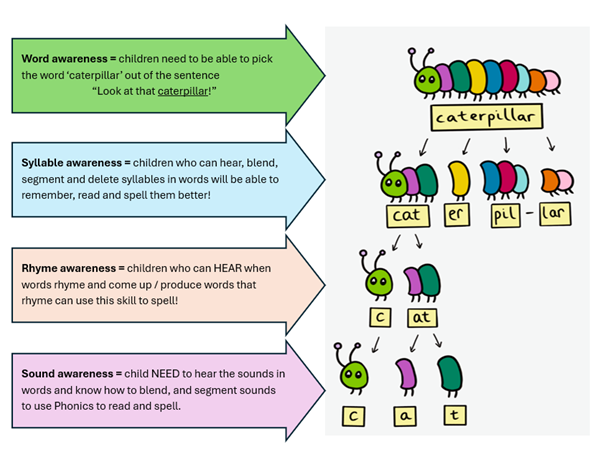
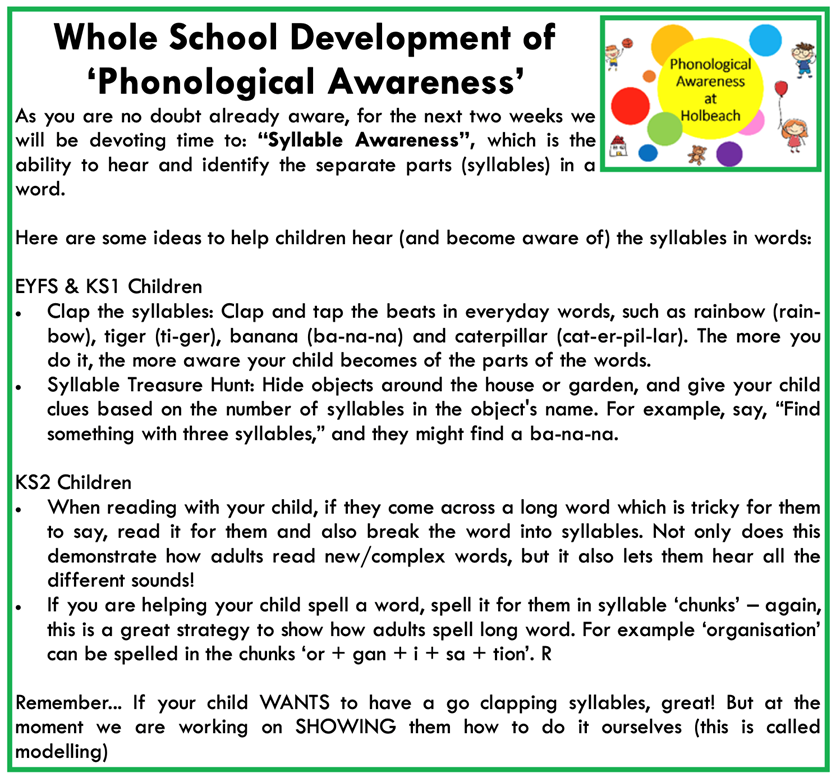
At Holbeach, all children from Nursery to Year 6 are being supported to develop their phonological awareness skills in the classroom and around the school. To encourage parents to join in, each week we share ideas in the school Newsletter on how to support phonological awareness at home. The announcements look like this:
Phonological Awareness resources
There are also thousands of other resources available online to help parents and carers develop children’s phonological awareness skills. Please see the list below:
Phonological Awareness Activity Pack - This activity pack is filled with amazing ideas to support phonological awareness at home.
Reading Rockets website - Reading Rockets is a great website to support children during their reading journey. This webpage explains the importance of phonological awareness and gives ideas for supporting it at home.
Phonological Awareness video - In this video, phonological awareness is explained, as well as the vital role it plays in supporting Phonics instruction.
How to develop phonological awareness – video examples
In the videos below, speech and language therapist, Bryony, demonstrated how you can support children to develop some basic phonological awareness skills.
· Supporting word awareness = children need to be able to hear and recognise where words begin and end (these are called word boundaries). This helps them as they begin to read and spell. To help them develop this skill, you can count words with them: Counting words video
· Supporting vocabulary = at school,children are asked questions such as “what is the first letter in the word dog?” To be able to understand and follow these instructions, they need to know the meaning of words such as ‘first’ and other concepts such as‘second, third, fourth, beginning, middle, end’. They also need to know what a‘word’, ‘sentence’ ‘sound’ and ‘letter’ are! To help them learn concept words,you can teach them during games: First, middle, last video and First, second, third video
· Syllable awareness = before children can begin to blend and segment syllables, they need to know what they are. To do this, we can start by making them AWARE that words can be broken into syllables. To help them become aware, we can clap (or tap) syllables in words: Syllable awareness video
· Blending syllables = being able to stick syllables together to make a word supports children being able to stick sounds together later on. This directly supports them to succeed with using Phonics to read. Here’s how to help children blend (stick together) syllables: Blending syllables video
· Segmenting syllables = just like with blending syllables, being able to segment syllables can support children to later break words into sounds. This directly supports them to succeed using Phonics to spell. Here’s how to help children segment (break apart) syllables: Segmenting syllables video
· Deleting syllables = when children can hold a word in their head and take a part away (delete a part), this can help them later on when taking away and adding sounds to words. Here’s how to help children delete (take away) syllables in words: Deleting syllables video